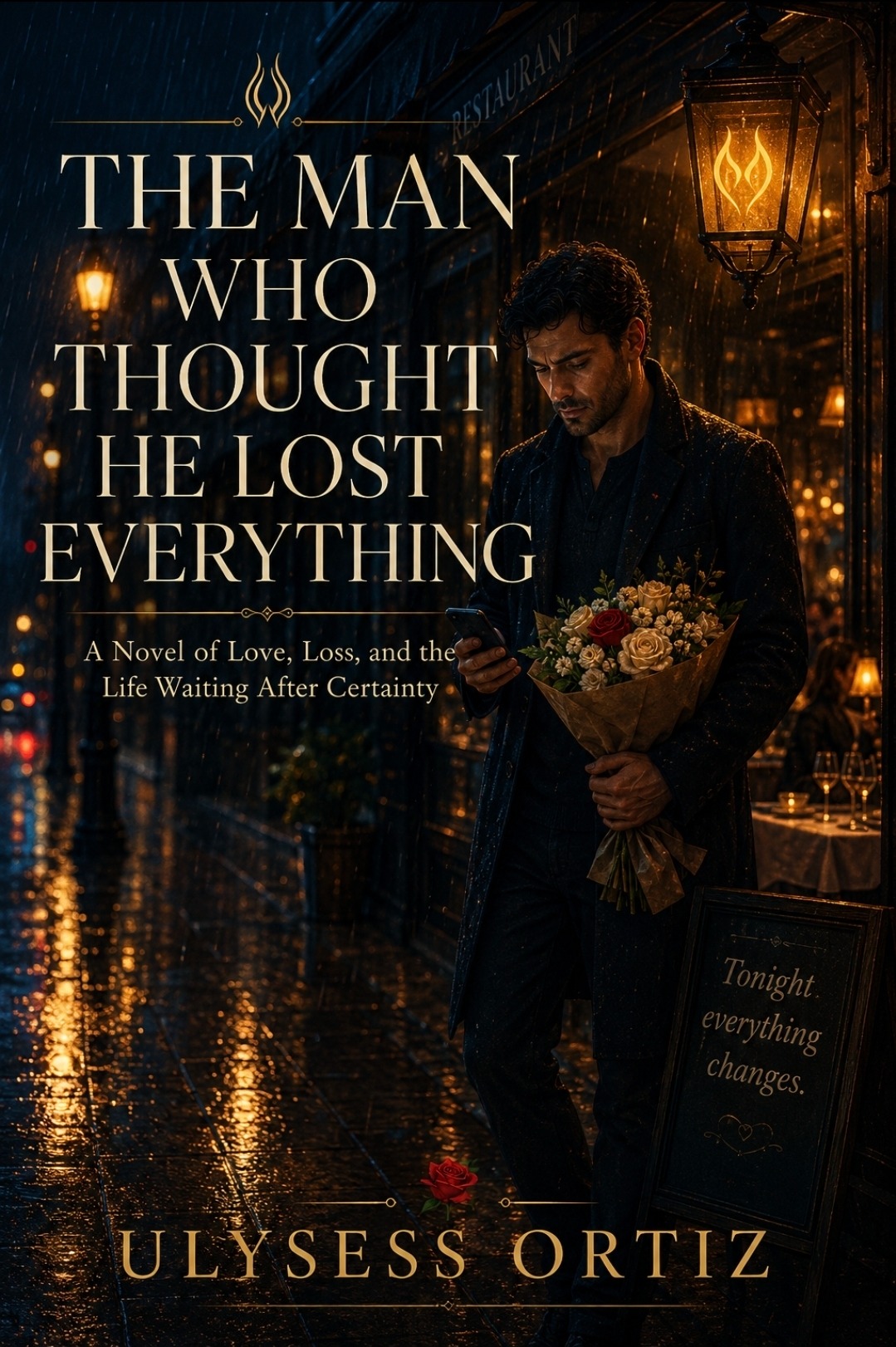
A Novel of Love, Loss, and the Life Waiting After Certainty
Elias Reyes builds a future around love and certainty. When that future fractures, Maya, grief, therapy, family, friendship, and the book he begins writing force him to ask who he is without the answer he was waiting for.
LanguageEnglishThe publication keeps its original language.
ELIAS AFTER THE ANSWER
The future Elias trusted disappears. The novel stays for what happens after.
Elias is not written as a man who simply needs to get over a loss. His relationship with Maya, the grief around Julian, therapy, family, friendship, humor, and the small rituals of ordinary life all remain active parts of the story. The question underneath them is more difficult: who is Elias when the answer he depended on is no longer available?
The title matters because it says he thought he lost everything. That word does not minimize what was taken from him. It opens a narrow space for the things that survive without replacing what he loved: writing, connection, care, memory, and the ability to inhabit a life that looks nothing like the one he planned.
THE HUMAN CENTER
Elias, Maya, and a future that no longer behaves
The relationship is not reduced to a villain, a martyr, or a neat lesson. The book lets tenderness and damage coexist while Elias confronts how much of his identity was built around getting one particular answer.
WHAT REBUILDING LOOKS LIKE
Therapy, family, friendship, and strange little corners of life
Recovery happens in ordinary rooms. A reading night at the Casa de la Linterna, conversations with friends, family interruptions, and the memory of Julian become evidence that life can accumulate without pretending to replace what is gone.
THE TONE
Intimate, wounded, sometimes funny
This is emotional literary fiction with romance at its center, but it does not stay in one register. Grief is allowed to be heavy, tenderness is protected, and humor can enter without canceling the pain.
THE QUESTION
Who is Elias without the answer?
That question gives the novel its shape. It is less interested in whether Elias can restore the old future than whether he can become a whole person without forcing uncertainty to resolve first.
WHAT YOU ARE NOT GETTING
A clean “move on” story
The book does not promise replacement love, instant closure, or a lesson that makes the losses worth it. It is about the more awkward work of living when the old definition of everything has broken.
Concrete details from the book
Elias arrives fifty-nine minutes early for his first date with Maya, with soft yellow and white flowers in the passenger seat.
Later chapters include therapy with Dr. Adler, Boba the cat, Mateo, Ruth, the Lantern House/Casa de la Linterna, and Elias writing the book inside the book.
Elias writes rules for that manuscript: no villains, no trophies, no courtroom, no rescue ending, return to self.
THE QUESTION
If the future you organized your identity around vanished, what would still count as your life?
CHOOSE THIS IF
You want character-first fiction about love, grief, identity, and rebuilding after certainty collapses.
You prefer emotional ambiguity, therapy, family, friendship, humor, and small acts of return over a tidy romantic formula.
You want a novel that treats continuing to live as different from replacing what was lost.
MAYBE NOT THIS ONE IF
You want a fast external plot or a romance whose main goal is a simple happily-ever-after resolution.
CONTENT NOTE
Adult emotional fiction. Grief, relationship pain, loss, and mental-health themes are central.